 Ελληνικά
 English
Why the door decides how the cold room performs
The door is the weakest point of any cold room. It opens and closes dozens of times a day, gets hit by pallet trucks, is washed down with water and detergent, and still has to seal properly year after year. If it falls short, you pay for it in energy, in ice around the frame and, at worst, in a broken cold chain.
In food, pharma and logistics, stainless steel is not a luxury. It is the surface that stands up to moisture, cleans easily and passes hygiene inspections. This guide covers what to ask for when you buy inox cold storage doors: the types available, when fire resistance is needed, which specifications to check, and which mistakes cost the most.
AMP (American Motors Pilalis) has built cold rooms and cold storage doors since 1963. We manufacture in Greece with German know-how and deliver fast worldwide. What follows comes from daily work in the factory and on customer sites.
What makes an inox cold storage door different
Not every stainless door is the same. Three things matter in practice:
- Material grade: AMP uses INOX 304, the stainless grade suited to food environments. It resists moisture and cleaning chemicals and does not rust at seams and corners, where problems usually start.
- Build precision: With manufacturing precision of 0.1mm, the leaf sits in the frame without gaps. Fewer gaps mean less cold loss and steadier temperatures.
- The right type for the job: A door that opens 200 times a day needs a different mechanism from one that opens twice. Choosing between hinged, sliding and electric doors has a direct effect on performance.
You get quality equivalent to German products at a lower cost. That comes from producing in Greece, backed by experience that goes back to 1963.
The main types of cold storage door
The right type depends on traffic, the space in front of the opening and the operating temperature. See the full AMP cold storage door range. The main categories are:
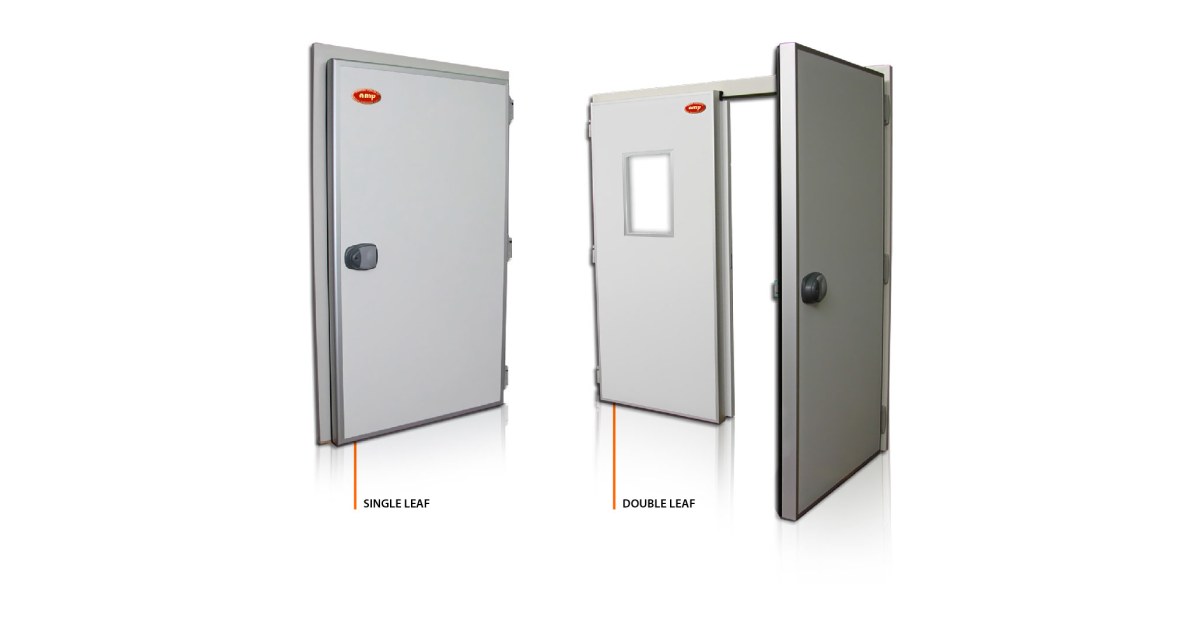
- Hinged: The hinged single-leaf door is the classic choice for small and medium rooms with limited traffic. The hinged flush door gives a smooth surface that is easy to clean.
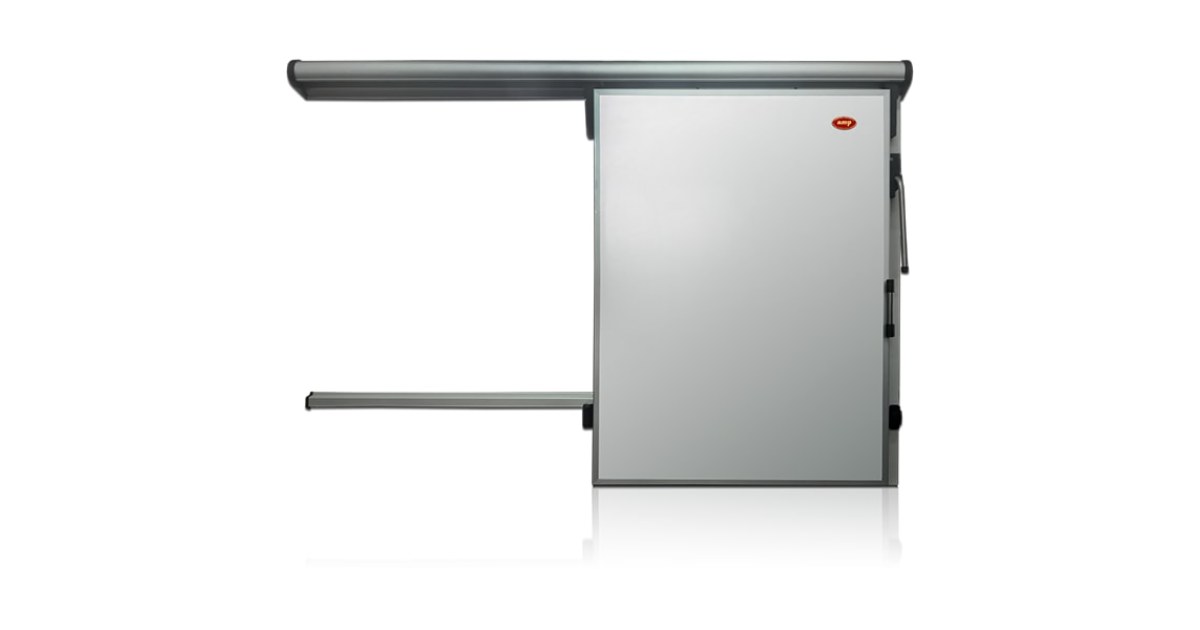
- Sliding: The sliding cold storage door saves space where an outward-swinging leaf will not fit, such as narrow corridors.
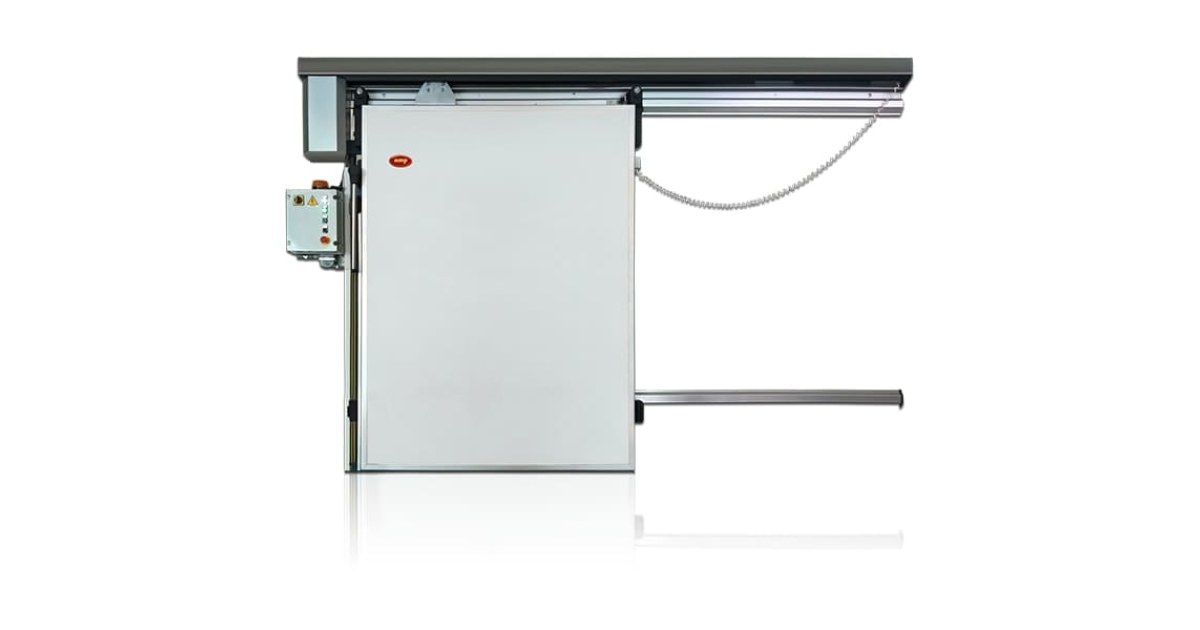
- Electric: The electric sliding door suits busy areas and loading routes where operators have their hands full. It opens and closes quickly and cuts the time the room stays open.
- Vertical sliding: The vertical sliding door works for large openings and for sites with no side space for a sliding leaf.
- ATMC: The ATMC sliding door is made for controlled-atmosphere rooms, where sealing is critical to preserving the product.
A practical rule: count how many times a day the door opens and what passes through it (people, trolleys, pallets). The answer usually narrows the choice to two types.
Fire resistance and compliance: EN 1634-1, EI2 60
If your cold room sits in an area where the fire-safety design calls for fire-rated elements, the door must be certified. The reference standard for fire-resistance testing of doors is EN 1634-1. The EI2 60 class means the door keeps its integrity and thermal insulation for 60 minutes.
AMP offers three fire-rated types:
Our fire-rated doors carry EN 1634-1 and EI2 60 certification, along with UL 10C and Intertek. Always ask for the certificate for the specific model. A general claim of "fire-rated" will not satisfy the fire authority.
Note that the other types in the range are not fire-rated. If your design requires fire resistance, say so at the start and choose from the three above.

Specifications worth checking
Before you request a quote, write down the points below. You will save time and compare offers properly.
- Operating temperature: Chilled or deep-freeze? Insulation thickness changes with it. For panels, roughly 60mm is typical for chilled storage and 100–140mm for deep freeze. The door must match the thickness of your cold room panels.
- Material and finish: Ask outright whether it is INOX 304, and on which faces (inside, outside or both).
- Opening size: Width and height measured against the pallet trucks and trolleys that pass through. Measure with the load on, not just the vehicle.
- Mechanism: Hinged, sliding, electric, vertical sliding or ATMC, based on how often the door is used.
- Sealing and fit: What build tolerance the manufacturer guarantees. We work to 0.1mm.
- Fire rating: If required, which class (EI2 60) and which certificates (EN 1634-1, UL 10C, Intertek).
- User safety: The ability to open the door from inside, so nobody gets trapped in the room.
- Spares and support: How fast parts ship and who handles installation.
Cost: what drives the price
You will not find a "from" price here, because there is no single price. The cost of an inox cold storage door depends on a few factors:
- the door type (a manual hinged door is a long way from an electric or fire-rated one),
- the opening dimensions,
- insulation thickness and operating temperature,
- fire rating and the related certificates,
- extra hardware, delivery and installation.
Do not judge on purchase price alone. A cheaper door with poor sealing costs you every month in energy and maintenance. AMP delivers quality equivalent to German products at a lower cost. For an exact price, send us the dimensions and the application and request a quote.
Common buying mistakes
- Choosing on price alone. A price gap often comes from thinner material, lower precision or missing certificates.
- Leaving fire rating until the inspection. If the design requires it, the door needs EN 1634-1 and EI2 60 before you order, not after installation.
- The wrong type for the traffic. A manual hinged door on a busy route means a door left open and lost cold. An electric door fits there.
- Mismatch with panel thickness. The door and panels should be designed together, otherwise you get thermal bridges at the frame.
- Measuring without the load. The opening must clear the pallet truck with the pallet on it, with room to spare.
- Overlooking hygiene requirements. In a food business, surfaces and seams must clean easily. Check the requirements of EFET (the Greek Food Authority) before you lock in the specification.
Conclusion
A good inox cold storage door is chosen for the job, not from the catalogue. Define temperature, dimensions and opening frequency, check whether fire resistance is required, and ask for INOX 304 in writing. That is how you avoid cold loss, maintenance bills and trouble at inspection.
AMP has built doors and cold rooms since 1963, in Greece, with German know-how and fast worldwide delivery. Browse the full door range or contact us with your project details and we will recommend the right solution.